Strategic Shifts in the Texas Housing Market: May 2026 Insights
The Texas housing market continues to be a dynamic landscape, characterized by robust new construction, significant population growth, and an evolving focus on affordability. A recent report from the Texas Real Estate Research Center (TRERC) for Spring 2026 sheds light on the key trends shaping the state's residential real estate sector, indicating a strategic pivot by builders towards more accessible price points amidst persistent affordability challenges
The Engine of Growth: New Construction and Population Influx
Historically, new construction has been the bedrock of Texas's housing market, fueling rapid expansion and attracting builders nationwide. The state's strong economy and continuous population growth have consistently driven demand for new homes. The period between 2000 and 2024 saw a remarkable influx of 2.14 million new residents to Texas, largely due to net migration during the COVID-19 pandemic. This demographic surge has had profound implications for housing demand.
In response to this demand, counties and municipalities across Texas issued a record number of building permits. For new single-family construction, 781,020 permits were authorized, marking a substantial 40.9 percent increase compared to the preceding five-year period (2015-2019). This figure even surpassed the number of permits issued during the 2000s housing boom (2002-2006) by nearly 85,000, or over 12 percent. Notably, Texas alone accounted for 16.5 percent of all new single-family permits nationally, a significant rise from its 10 percent share during the earlier boom
Shifting Tides: The Evolution of Price Segments
The composition of the new home market in Texas has undergone significant shifts, primarily influenced by mortgage rates, home prices, and overall affordability. Builders have strategically adapted their offerings to remain competitive and address the purchasing power erosion caused by rising costs.
Pre-Pandemic Dominance of Lower-Priced Homes (2017-Early 2020): Prior to the pandemic, new homes priced below $250,000 constituted approximately 35-40 percent of all new home sales. Homes under $300,000 consistently represented more than half of new construction, ranging from 50-56 percent. In contrast, homes priced above $500,000 held a modest share of about 9-10 percent.
The Pandemic's Impact: A Surge in Higher-Priced Homes (2020-2022): The Federal Reserve's emergency rate cuts in March 2020 led to ultra-low mortgage rates, enabling many buyers to afford more expensive properties. Consequently, the share of lower-priced new construction rapidly declined. By Fall 2022, homes under $250,000 dropped to just 7 percent, and those under $300,000 fell to the low 20 percent range. Concurrently, the share of new homes priced above $500,000 surged to a record 25-26 percent. This shift was also driven by rising construction costs, supply chain issues, labor pressures, and increasing land prices.
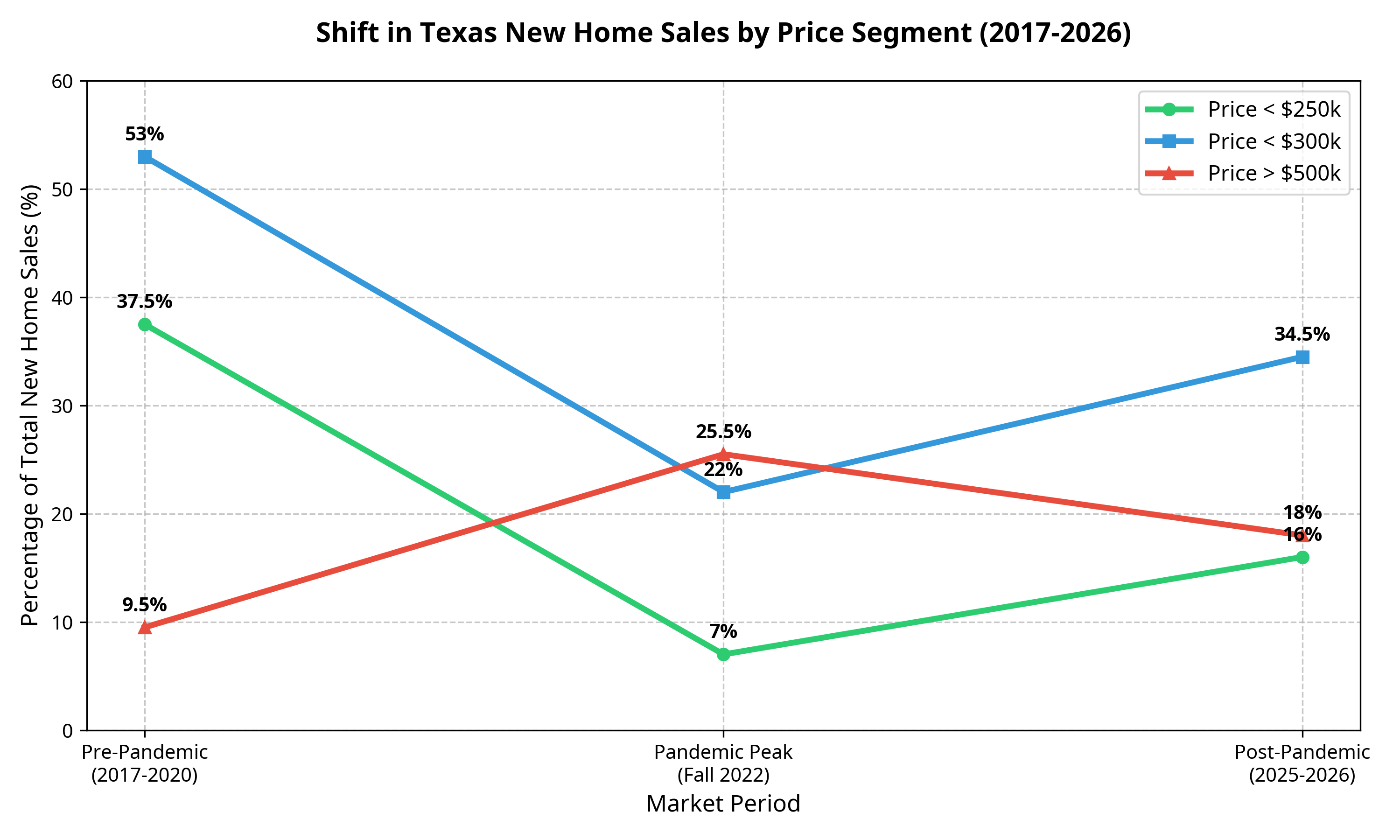
Post-Pandemic Pivot Towards Affordability (2023-2025): Beginning in 2023, a gradual but steady rebound in smaller, lower-priced construction signaled a structural shift back towards affordability. By 2025, homes priced below $250,000 had increased to approximately 15-17 percent, and those below $300,000 reached about 33-36 percent. While these figures remained below pre-pandemic levels, they indicated a clear trend. Conversely, the share of new homes priced above $500,000 declined notably, falling below 20 percent by 2025 after peaking in mid-2022.
The Current Landscape and Future Outlook
As of Spring 2026, the Texas housing market is experiencing a period of normalization. Forecasts from TRERC suggest a modest increase in home sales, rising approximately 2.5 percent to roughly 349,000 units, with the median home price appreciating by about 1.3 percent to around $334,000. Mortgage rates, which were reported at 6.30 percent as of April 30, 2026, are generally expected to hover between 5.9 percent and 6.3 percent for the year.
Despite the positive indicators of growth and a strategic shift towards affordability by builders, the challenge of affordability remains a primary concern for first-time buyers and households with modest incomes. The renewed emphasis on lower price segments represents a critical supply-side response that will continue to influence inventory and the broader trajectory of the housing market in the coming years. Texas's continued population growth, with 391,243 new residents in 2025 bringing the total to 31.7 million, underscores the ongoing demand for housing.